

You check your Tesla’s tires and notice something strange. The outside of the tire still looks reasonably good, but the inside edge looks almost worn out.

It’s frustrating, especially when you haven’t had the tires for very long.
You might wonder whether this is simply part of owning a Tesla or whether something is wrong with your vehicle.
The important thing to understand is that uneven tire wear is a warning sign, not something you should automatically consider normal.
Several things can cause Tesla tires to wear on the inside edge. Incorrect wheel alignment is one possibility, particularly when camber or toe angles fall outside the recommended specifications. Suspension problems, road impacts, tire pressure, and driving habits can also affect tire condition.
The tricky part is that these problems don’t always produce obvious symptoms while you’re driving.
In this guide, we’ll explain what causes inside-edge tire wear, how to recognize it, what a technician should check, and when professional Tesla wheel alignment may help.
If you’re a Tesla owner in Houston, we’ll also explain how Zero Pull Alignment can help you investigate alignment-related tire wear.
Quick Answer: Why Are My Tesla Tires Wearing on the Inside Edge?
Tesla tires can wear on the inside edge when the wheels don’t maintain the correct alignment or when other mechanical and maintenance issues affect how the tires contact the road.
Common causes include:
- Excessive negative camber: The top of the wheel leans too far inward, which can increase wear along the inner shoulder.
- Incorrect toe alignment: The tires point slightly in the wrong direction and scrub against the road as the vehicle moves.
- Worn suspension components: Damaged or loose components can affect wheel positioning.
- Road impacts: Potholes and curbs can damage suspension parts or change alignment.
- Incorrect tire pressure: Improper inflation can contribute to irregular tread wear.
The best way to identify the actual cause is to inspect the tires, check relevant suspension components, and measure the wheel alignment.
Replacing the tires without investigating the reason for the uneven wear may leave the original problem unresolved.
1. Excessive Negative Camber: One Possible Cause of Inside-Edge Tire Wear
Let’s start with camber because it’s one of the alignment angles worth checking when a Tesla develops unusual inner-edge wear.
Camber describes the inward or outward tilt of a wheel when you look at the vehicle from the front or rear.
When the top of the tire leans inward toward the vehicle’s centerline, the wheel has negative camber.
A certain amount of negative camber is normal. Vehicle manufacturers use specific alignment settings to balance handling, stability, and tire contact with the road.
The problem starts when the camber angle moves outside the recommended range.
For example, imagine that the top of a wheel leans farther inward than the manufacturer’s specifications allow. This can increase the load on the inner portion of the tire and contribute to uneven tread wear.
Over time, you may notice that the inside shoulder wears down faster than the center or outside of the tire.
Does Negative Camber Always Mean Something Is Wrong?
No.
Negative camber by itself doesn’t automatically indicate a problem. The correct angle depends on the vehicle’s model, year, suspension design, and manufacturer specifications.
What matters is whether the measured angle falls within the appropriate range and whether the tire shows an abnormal wear pattern.
A technician should measure the camber rather than judge it by looking at the wheel.
Can a Technician Correct Tesla Camber?
That depends on the particular Tesla and its suspension configuration.
Some alignment angles may allow adjustment, while others may require further investigation if the readings fall outside specifications.
A technician should first identify the affected angle and check for worn or damaged components. If the vehicle allows adjustment, the technician can determine the appropriate correction.
The goal isn’t simply to make the wheel look straight. It’s to bring the alignment measurements within the manufacturer’s applicable specifications.
2. Incorrect Toe Alignment Can Wear Down Your Tesla Tires
Camber isn’t the only angle that can cause uneven tire wear.
Toe alignment is another important measurement, and incorrect toes can cause tires to wear surprisingly quickly.
Imagine looking at your Tesla from directly above.
If the front edges of the tires point slightly toward each other, the wheels have toe-in. If they point away from each other, they have toe-out.
Manufacturers specify the appropriate toe settings for each vehicle.
When those settings fall outside the recommended range, the tires may scrub against the road instead of rolling in the intended direction.
Think about pushing a shopping cart while one wheel points slightly sideways. That wheel doesn’t roll as smoothly as the others. It drags and creates unnecessary friction.
Incorrect toe alignment can create a similar effect on your tires.
You may notice:
- Uneven wear across the tread blocks.
- A feathered or saw-tooth tread pattern.
- Faster tire wear than expected.
- A change in steering feel.
- A vehicle that doesn’t track straight.
How Does a Toe Alignment Inspection Help?
A computerized wheel alignment inspection measures the relevant toe angles and compares them with the vehicle’s specifications.
If the measurements fall outside the recommended range, a technician can check whether the angles are adjustable and make the necessary corrections where applicable.
This is particularly important when your Tesla develops uneven tire wear soon after installing a new set of tires.
3. Tesla’s Instant Torque and Driving Habits Can Affect Tire Life
Tesla vehicles deliver power differently from many traditional gasoline-powered vehicles.
Electric motors can provide strong acceleration almost immediately. That’s one reason many Tesla owners enjoy the driving experience.
However, aggressive acceleration, hard cornering, and frequent spirited driving can contribute to faster tire wear.
Vehicle weight also plays a role. The battery pack adds substantial weight, and the tires must support that weight while maintaining traction during acceleration, braking, and cornering.
Your tire selection matters, too.
Performance tires are designed with handling and traction in mind. Depending on the tire compound, driving conditions, and usage, they may wear differently from tires designed primarily for longer tread life.
But there’s an important distinction here.
Fast overall tire wear and inside-edge tire wear are not exactly the same problem.
Aggressive driving and vehicle weight can contribute to general tire wear. However, if one particular edge wears much faster than the rest, you should investigate the alignment and suspension rather than automatically blaming the vehicle’s weight or electric motor.
4. Worn Suspension Components Can Cause Alignment Problems
Have you ever had your vehicle aligned, only to notice uneven tire wear returning later?
In that situation, the alignment readings may not be the only thing that needs attention.
Your Tesla’s suspension system contains several components that help maintain proper wheel positioning.
Depending on the model and suspension design, these include control arms, bushings, ball joints, links, and other steering and suspension components.
Over time, a component can become worn, damaged, or loose.
A pothole, curb impact, or normal wear can also affect suspension condition.
When a component no longer holds the wheel in its intended position, alignment angles may change or become difficult to maintain.
This is why a technician shouldn’t automatically assume that an alignment adjustment alone will solve every tire-wear problem.
What Should a Technician Check?
Before making alignment adjustments, a technician should inspect the relevant suspension and steering components.
The inspection may include:
- Checking for worn or damaged bushings.
- Looking for loose or damaged suspension connections.
- Inspecting relevant steering components.
- Checking for signs of impact damage.
- Looking for anything that could affect wheel positioning.
If a component needs repair or replacement, the technician should address that problem before completing the alignment.
Otherwise, the vehicle may continue to develop uneven tire wear even after an alignment service.
5. Incorrect Tire Pressure Can Also Contribute to Uneven Wear
Tire pressure is easy to overlook, but it has a direct effect on tire performance and condition.
When a tire has too little or too much air, its tread may not contact the road as intended.
For example:
- Underinflation can contribute to increased wear along both shoulders of a tire.
- Overinflation can contribute to increased wear around the center of the tread.
These are general wear patterns, not a reliable diagnosis on their own.
Incorrect tire pressure doesn’t necessarily explain isolated inside-edge wear. However, it’s still an important part of a complete tire inspection.
How Should You Check Tesla Tire Pressure?
Don’t guess the correct pressure based on another Tesla owner’s vehicle.
Tesla recommends using the tire pressures shown on the Tire and Loading Information label for your particular vehicle. You can usually find this label on the driver’s side door pillar.
Check tire pressure when the tires are cold and use an accurate pressure gauge.
If you recently changed your tires or wheels, also make sure your vehicle has the correct tire and wheel configuration.
For more information, see Tesla’s official Tire Repair and Maintenance Guide.
6. Houston Potholes and Road Conditions Can Affect Your Tesla’s Alignment
Road conditions are another factor worth considering.
Houston drivers encounter different road surfaces, construction areas, uneven pavement, potholes, and occasional curb impacts.
A single impact doesn’t always cause a noticeable problem. However, a sufficiently hard hit can damage a wheel or suspension component and may affect alignment.
You might not notice anything immediately.
The vehicle may still drive normally, but the tires could begin developing an uneven wear pattern over time.
If you notice unusual tire wear after hitting a pothole or curb, consider having the wheels, tires, suspension, and alignment inspected.
Don’t assume the problem will disappear on its own.
7. How to Recognize Inside-Edge Tire Wear Before It Gets Worse
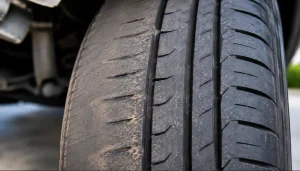
One reason this problem catches Tesla owners by surprise is that the most damaged part of the tire may be difficult to see.
When you stand beside your vehicle, you mainly see the outside shoulder. The inner shoulder sits closer to the underside of the car.
As a result, the outside tread may look healthy while the inside has already lost a significant amount of rubber.
Here are some warning signs to look for.
The Inner Shoulder Looks More Worn
Compare the tread depth across the inner, middle, and outer sections of the tire.
If the inner shoulder has noticeably less tread, ask a tire professional to inspect it.
The Tread Looks Feathered
Run your eyes across the tread blocks.
If one side of the tread blocks appears smoother while the other side feels sharper, the tire may have a feathered wear pattern.
Incorrect toe alignment is one possible cause, although an inspection is necessary to confirm it.
Your Tesla Pulls to One Side
Does your Tesla drift left or right when you’re trying to drive straight on a level road?
Incorrect alignment may contribute to this behavior, although tire pressure, road surface, and other mechanical issues can also affect steering.
The Steering Wheel Doesn’t Sit Straight
If your steering wheel appears off-center while the vehicle travels straight, the alignment may need attention.
This symptom doesn’t confirm inside-edge wear by itself, but it’s worth investigating.
You Notice Unusual Tire Noise or Vibration
Uneven tread wear can sometimes produce additional road noise or vibration.
However, wheel imbalance, tire damage, and other problems can create similar symptoms.
Don’t rely on sound or steering feel alone. Have the tires inspected.
Safety note: If the inner shoulder is severely worn, the tire has visible structural cords, or you notice a bulge or other significant damage, don’t continue driving on it. Arrange a professional tire inspection and replacement if necessary.
8. How a Professional Tesla Wheel Alignment Inspection Works
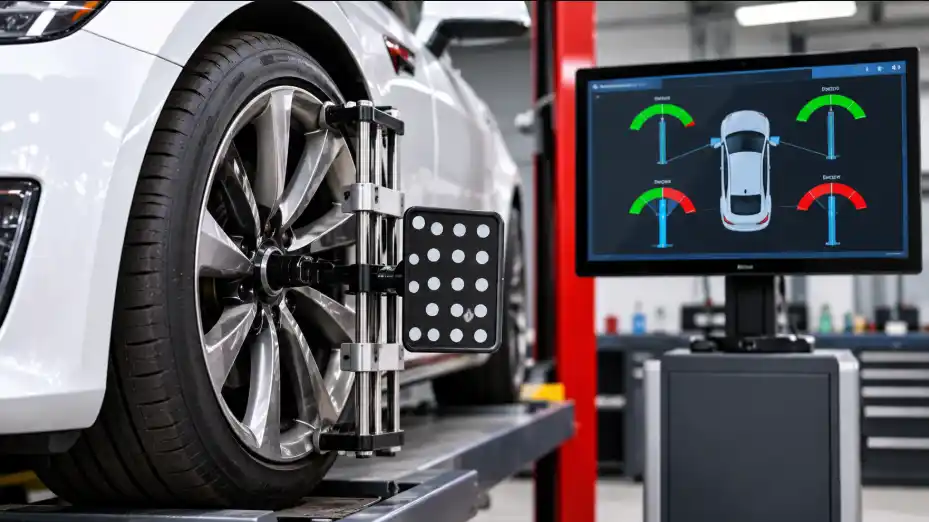
Once you notice uneven tire wear, the next question is simple:
What should happen during an alignment inspection?
A proper service should do more than connect an alignment machine and change a few numbers.
The technician needs to understand the tire-wear pattern, inspect relevant components, and compare the vehicle’s measurements with the correct specifications.
Here’s what the process can involve.
Step 1: Inspect the Tires
The technician examines the tires for uneven tread wear, inner-shoulder damage, feathering, and other visible problems.
Where appropriate, the technician can measure tread depth across different parts of the tire.
This helps establish whether the wear is concentrated in a particular area.
Step 2: Inspect Relevant Suspension and Steering Components
Before adjusting the alignment, the technician checks whether worn or damaged components could affect the measurements.
If the vehicle has a mechanical problem, that issue may need attention first.
Step 3: Measure the Wheel Alignment
A computerized alignment system measures the wheel angles.
Depending on the vehicle and equipment, the inspection may include camber, caster, and toe measurements.
Step 4: Compare the Results With Manufacturer Specifications
The technician compares the measurements with the appropriate specifications for the specific Tesla model and configuration.
This is important because different vehicles can have different alignment requirements.
Step 5: Make Applicable Adjustments
If the measurements fall outside the recommended range, the technician determines which angles can be adjusted.
The available adjustments depend on the vehicle’s design and component condition.
Step 6: Verify the Final Measurements
After completing the applicable adjustments, the technician checks the measurements again.
A before-and-after alignment report can help show which angles changed and whether the final readings fall within the applicable specifications.
The purpose of the inspection is to identify the problem accurately, not simply to make the numbers look better.
9. How Zero Pull Alignment Helps Tesla Owners in Houston
If your Tesla tires are wearing unevenly, you probably don’t want to replace another expensive set without understanding why it happened.
That’s where a proper inspection becomes important.
At Zero Pull Alignment, we provide wheel alignment services for drivers in Houston, TX.
Our approach focuses on computerized alignment measurements, relevant suspension inspections, and professional adjustments where applicable.
Whether you drive a Tesla Model 3, Model Y, Model S, Model X, or Cybertruck, the correct alignment specifications and available adjustments depend on your vehicle’s configuration.
When you bring your vehicle in for an alignment inspection, the goal is to understand what’s happening before recommending a correction.
Our service process includes:
- Computerized Alignment Measurements: Identify whether the measured wheel angles fall outside the applicable specifications.
- Relevant Suspension Inspection: Look for components that may affect wheel positioning.
- Camber and Toe Evaluation: Investigate alignment angles that may contribute to uneven tire wear.
- Applicable Alignment Adjustments: Correct adjustable angles where the vehicle’s design allows.
- Before-and-After Measurements: Review the alignment results after the service.
If you’re experiencing inside-edge tire wear, don’t wait until the remaining tread becomes unsafe.
Learn more about our Tesla Wheel Alignment Service in Houston.
10. How Often Should You Check Your Tesla Tires and Wheel Alignment?
You don’t need to wait until a tire looks badly damaged before checking its condition.
Regular tire inspections can help you identify uneven wear early.
Tesla recommends rotating tires every 6,250 miles or when the difference in tread depth between two tires reaches 2/32 inch, whichever comes first. The appropriate rotation method depends on the tire and wheel configuration.
Tesla also recommends wheel alignment when you notice uneven tire wear or when the vehicle pulls left or right while the steering wheel is held straight.
Wheel alignment is also recommended after installing a new set of tires.
Remember that tire rotation and wheel alignment serve different purposes.
- Tire rotation changes the positions of the tires to help distribute tread wear.
- Wheel alignment checks and corrects wheel positioning where adjustments are available.
Rotating your tires won’t correct incorrect camber or toe settings.
You can read Tesla’s official Vehicle Maintenance Recommendations for more information.
11. Should You Replace Your Tesla Tires or Get an Alignment First?
This depends on the condition of the tires and the reason for the uneven wear.
If the tires still have safe tread depth and no structural damage, a technician can inspect the alignment and suspension to determine whether a correction may help prevent further uneven wear.
However, alignment cannot restore rubber that has already worn away.
If the inner shoulder has become severely worn, the tire may need replacement even after the alignment problem is corrected.
Think of it this way:
- A wheel alignment can address an alignment problem.
- A suspension repair can address a damaged or worn component.
- Tire replacement addresses a tire that has become unsafe or worn beyond an acceptable level.
Sometimes a vehicle needs more than one of these services.
The important thing is to identify the actual problem before spending money on another set of tires.
12. Don’t Ignore Inside-Edge Tire Wear on Your Tesla
If your Tesla’s tires look healthy from the outside but show significant wear along the inner shoulder, take a closer look.
The problem may involve camber, toe alignment, suspension condition, tire pressure, or road-impact damage.
You don’t need to guess which one is responsible.
A proper tire and suspension inspection, followed by computerized alignment measurements, can help identify the underlying issue.
If you’re in Houston and your Tesla has developed uneven tire wear, Zero Pull Alignment can help you investigate the alignment-related causes and determine whether adjustments are appropriate.
Schedule Your Tesla Wheel Alignment in Houston
Don’t wait until an uneven wear pattern forces you to replace another set of tires.
Contact Zero Pull Alignment to discuss your vehicle’s symptoms and schedule an inspection.
Zero Pull Alignment
Houston, TX
Call: (346) 916-2567
Learn More About Tesla Wheel Alignment in Houston
Frequently Asked Questions About Tesla Tires Wearing on the Inside Edge
1. Why are my Tesla tires wearing on the inside edge?
Inside-edge tire wear can develop when camber or toe alignment falls outside the recommended specifications. Worn suspension components, road impacts, and other maintenance issues can also contribute. A professional inspection can help identify the actual cause.
2. Is inside tire wear normal on a Tesla Model 3?
Significant inside-edge wear shouldn’t automatically be considered normal. Some Tesla owners experience accelerated tire wear, but excessive wear on one edge deserves an inspection of the alignment, suspension, and tire condition.
3. Why are my Tesla Model Y rear tires wearing on the inside?
Several factors can contribute, including rear-wheel alignment settings, suspension condition, tire pressure, and driving habits. A technician should measure the rear alignment angles and inspect relevant components rather than assume one cause.
4. Can negative camber cause inside-edge tire wear?
Yes. Excessive negative camber can increase the load on the inner shoulder and contribute to uneven tread wear. However, the correct camber setting depends on the vehicle’s specifications.
5. Can incorrect toe alignment damage Tesla tires?
Yes. Incorrect toe settings can cause the tires to scrub against the road, which may create rapid or feathered tread wear. A computerized alignment inspection can help identify toe-related problems.
6. Will wheel alignment fix inside-edge tire wear?
Wheel alignment can help address uneven wear caused by incorrect adjustable alignment angles. However, it cannot restore already-worn tread or repair damaged suspension components. Severely worn tires may still need replacement.
7. How often should I rotate my Tesla tires?
Tesla recommends tire rotation every 6,250 miles or when the tread-depth difference between two tires reaches 2/32 inch, whichever comes first. Always check the requirements for your particular tire and wheel configuration.
8. Can potholes affect Tesla wheel alignment?
Yes. A significant pothole or curb impact can damage a wheel or suspension component and may affect alignment. If your vehicle develops unusual tire wear or steering symptoms after an impact, schedule an inspection.
9. Can I drive with excessive inside-edge tire wear?
It depends on the tire’s condition. If the inner shoulder has severe wear, exposed structural cords, a bulge, or other significant damage, don’t continue driving on it. Arrange an immediate professional inspection.
10. Where can I get Tesla wheel alignment in Houston?
Zero Pull Alignment provides wheel alignment services in Houston, TX. You can contact the shop at (346) 916-2567 to discuss your Tesla’s alignment concerns and arrange an inspection.
11. Does tire rotation fix an alignment problem?
No. Tire rotation changes the position of the tires on the vehicle. Wheel alignment measures and corrects wheel angles where adjustments are possible. Rotation cannot correct incorrect camber or toe settings.
12. Should I get a wheel alignment after replacing Tesla tires?
Tesla recommends wheel alignment after installing a new set of tires. An alignment inspection can help identify whether the wheel angles need attention and support proper tire wear.
Still have questions about your Tesla’s tire wear? Call Zero Pull Alignment at (346) 916-2567 to discuss your concerns.
It is one of those issues that some of the Tesla owners learn about once they take their car for a tire checkup and notice that the inner part is more worn out than the other parts.
But why does it happen?
There are several reasons why the tires become worn-out from the inside. They include wheel alignment, specifically camber and toe. In addition, the suspension, tire pressure, road conditions, and driving manner are also important factors.
Tesla cars provide great acceleration and good handling. Nevertheless, these attributes shouldn’t make you forget about checking the inside of the tires and replacing them.
If you have such a problem, simply replacing them without establishing the causes could mean additional expenses later on.
Here is the reason why Tesla car tires wear out inside and ways to solve the problem.
If you own the Tesla and live in Houston, try our Tesla-specific wheel alignment services provided by Zero Pull Alignment.
Quick Answer: Why Do Tesla Tires Wear on the Inside Edge?
Tires by Tesla are often affected by inner-edge wear due to improper alignment. Negative camber and improper toe values can contribute to the tire rubbing on the surface of the road.
Other reasons behind this issue can be worn-out suspension parts, wrong air pressure in tires, damage caused by hitting a pothole, or other conditions.
A professional alignment check will help find the real reason. If the problem lies in the alignment, readjustment will help to prevent further issues. Nevertheless, the tire can still require replacement.
1. Excessive Negative Camber: A Common Reason for Inside Tire Wear
Camber angle is one of the factors that should be evaluated to understand why the Tesla experiences inside-edge tire wear.
In essence, the camber angle indicates the position of the wheels of the car in respect to each other. The camber angle shows how the tire tilts from vertical when looking at it from the front or back.
In case the upper part of the tire slants inward, towards the centerline of the car, it is said to have negative camber.
It is normal for a car to have a particular amount of negative camber angle.
However, the problem is in case it exceeds the recommendation from the producer’s angle. Suppose that you use your Tesla on a daily basis with excessive negative camber. This way, it will place greater load on the inner edge of the tire. Thus, it will deteriorate much sooner than the outer part and the center of the tire.
Can Negative Camber Be Adjusted on a Tesla?
This will depend on the type, age, suspension setup, and adjustability points of the Tesla vehicle in question.
It is advisable to have the current camber angle checked by a technician using a computerized alignment machine to see how it compares to the manufacturer’s specified angle.
In case the camber is out of spec, the next step would be to find out whether adjustment is possible or not.
Adjusting negative camber, when applicable, could prove helpful in improving the tire’s contact with the road surface.
2. Incorrect Toe Alignment Can Cause Premature Tire Wear
Camber isn’t the only alignment angle that deserves attention.
Toe alignment is another important factor that can contribute to uneven tire wear.
To understand the toe, imagine looking down at your Tesla from above. The direction in which the front edges of the tires point is called the toe.
- Toe-in means the front edges point slightly toward each other.
- “Toe-out” means the front edges point slightly away from each other.
Both settings need to remain within the vehicle’s recommended specifications.
When toe alignment is incorrect, the tires may not roll in the direction they’re pointing. Instead, they experience sideways friction as the vehicle moves forward.
This is commonly known as tire scrubbing.
You might not notice anything unusual while driving, but the tires can gradually develop uneven tread wear. In some cases, you may also notice a feathered pattern across the tread blocks.
How Does Toe Adjustment Help?
A four-wheel alignment test will be able to gauge the toe angle on both ends, determining if they are out of specification.
In cases where the angles are adjustable, they can be corrected in order to decrease unnecessary friction on the road from the tires.
The checking of the toe alignment will be essential for those Tesla drivers suffering from premature tire wear and need to find the cause.
3. Tesla’s Weight and Instant Torque Can Affect Tire Life
There are certain aspects that characterize Tesla cars and thus call for proper tire maintenance.
Their batteries are heavy, whereas electric motors deliver instant torque. It makes additional requirements for the tires, especially during aggressive acceleration and cornering.
What does a sudden burst of speed do to your tires?
It needs to deliver that power directly to the road surface.
Aggressive acceleration can eventually lead to increased tread wear.
It is also important which kind of tires you install in your vehicle.
Performance tires focus on traction and handling, and thus their lifespan may be different from that of tires that are optimized for longevity.
Nevertheless, there is one crucial point.
Tesla car weight and instant torque can influence the wear process, yet they cannot be the sole factors that affect the inner part of the tires only.
4. Worn Suspension Components May Be Contributing to the Problem
Have you been through an alignment but then found yourself back in the problem of tire wear?
If yes, you may actually be experiencing a problem that is not with the alignment itself.
The Tesla suspension system consists of a number of parts responsible for ensuring that the wheels stay in place.
Such parts are control arms, bushings, ball joints, and others.
Eventually, certain parts start to get old, wear out, or even damage.
As a result, wheel angles will change due to driving forces and will be hard to set right via alignment.
Sometimes an alignment correction will not be enough to deal with the problem.
Why a Suspension Inspection Matters
Prior to aligning your wheels, the corresponding suspension and steering parts should be checked.
In case you have a damaged or worn part, it might need to be repaired or replaced before you could achieve proper alignment.
At Zero Pull Alignment, checking the corresponding suspension and alignment parts is an essential step in figuring out the reason behind tire wear in your Tesla.
The goal is to find out what the issue is, rather than just changing alignment settings without finding out what causes them.
5. Incorrect Tire Pressure and Road Conditions Can Also Affect Tire Wear
However, the alignment of the tires is not the only factor affecting tire wear and longevity.
The pressure within the tires affects how the tire will interact with the road surface, where too much or too little pressure might result in irregular tread wear.
Too little tire pressure might cause shoulder tire wear, while too much pressure might cause more wear on the tire’s central part.
Although such information is not universally applied but rather is indicative, it might still be helpful when performing tire inspections.
Also, do not forget about the road conditions.
Driving through potholes, striking curbs, or driving on a rough road regularly might negatively affect the wheels’ alignment or even damage some suspension components.
In case if your Tesla has recently developed signs of irregular tire wear after hitting a pothole, you should consider checking your wheels’ alignment.
Never forget to use the recommended tire pressure value according to your specific Tesla model and tire set.
6. How to Recognize Inside-Edge Tire Wear on Your Tesla
This problem could go undetected because the inner shoulder of the tire is not necessarily visible in a standard pre-ride check-up.
One may examine the external surface of their Tesla’s tires and conclude that everything is okay.
However, further inspection could reveal otherwise.
One should focus on the difference in the wear level between the inner, central, and outer parts of each tire.
If the inner shoulder is wearing faster, it is advisable to pay attention to it.
Feathering may be present, or the car may tend to drift to one side while driving or the steering wheel will not be aligned anymore while driving straight.
None of these signs alone indicates a misalignment. However, these are valid reasons to consider an inspection.
If the inner shoulder is heavily worn, if the tire is damaged, or the structural cords are showing, it is advisable to immediately have an inspection performed.
7. How Professional Tesla Wheel Alignment Works Helps Address Uneven Tire Wear
If your Tesla’s tires are wearing unevenly, replacing them without investigating the cause may lead to the same problem happening again.
That’s why a proper alignment inspection matters.
A professional Tesla wheel alignment service measures the vehicle’s wheel angles and compares them with the appropriate factory specifications.
At Zero Pull Alignment in Houston, the alignment process includes several important steps.
Tire and Suspension Inspection
The process starts with examining the tire wear pattern and checking relevant suspension and steering components.
This helps identify potential problems before adjustments are made.
3D Computerized Wheel Alignment
A 3D computerized alignment system measures the vehicle’s wheel positioning.
The measurements help identify whether camber, caster, and toe angles are within the appropriate specifications.
Review of Factory Specifications
The measurements are compared with the relevant factory specifications for the particular Tesla model.
This helps identify which angles may require attention.
Professional Alignment Adjustments
Where adjustments are possible, the necessary corrections can be made to bring the relevant wheel angles within the appropriate specifications.
The available adjustments depend on the vehicle’s suspension design and component condition.
Final Verification and Alignment Report
After adjustments, the measurements are checked again.
A before-and-after alignment report helps you understand what was outside specification and what changed during the service.
The objective is to help your Tesla maintain proper wheel positioning, improve driving stability, and reduce preventable tire wear.
8. Why Choose Zero Pull Alignment for Tesla Wheel Alignment in Houston?
When your Tesla starts wearing tires unevenly, finding the cause matters just as much as correcting the alignment.
At Zero Pull Alignment, we provide Tesla-specific wheel alignment services in Houston, TX.
Our service is designed around accurate computerized measurements, relevant suspension inspections, and professional adjustments where applicable.
Whether you drive a Model 3, Model Y, Model S, Model X, or Cybertruck, proper wheel positioning is an important part of maintaining your vehicle’s handling and tire condition.
Here’s what you can expect from our service:
- Tesla-specific wheel alignment.
- 3D computerized alignment measurements.
- Camber, caster, and toe adjustments where applicable.
- Inspection of relevant steering and suspension components.
- Before-and-after alignment report.
We understand how frustrating it can be to replace expensive tires and then discover the same wear pattern developing again.
That’s why our approach focuses on identifying possible causes before recommending alignment corrections.
If you’re experiencing inside-edge tire wear in Houston, you can learn more about our service here:
Tesla Wheel Alignment Houston:
https://zeropullalignment.com/tesla-wheel-alignment-houston/
9. When Should You Have Your Tesla’s Wheel Alignment Checked?
You don’t need to wait until your tires are completely worn out before checking the alignment.
Consider scheduling an inspection if:
- The inside edge of your tires is wearing faster than the rest of the tread.
- Your Tesla consistently pulls to one side.
- The steering wheel feels off-center.
- You’ve recently hit a significant pothole or curb.
- Suspension or steering components have been repaired.
- Your new tires are showing unusual wear.
- Your vehicle doesn’t feel as stable as it used to.
It’s also worth remembering that tire rotation and wheel alignment are two different maintenance services.
Rotating your tires changes their positions on the vehicle. It does not correct incorrect camber or toe settings.
For applicable Tesla vehicles, the manufacturer recommends tire rotation every 6,250 miles or when the tread-depth difference between two tires reaches 2/32 inch, whichever comes first. Always check the maintenance guidance for your specific vehicle and tire configuration.
Regular inspections can help identify problems before they lead to additional tire replacement costs.
10. Don’t Replace Another Set of Tesla Tires Without Investigating the Cause
If you have observed that your Tesla tires are more worn on their inner side than the rest of the tire tread, you should pay attention to this issue.
Replacing the tires might fix the immediate problem, but it does not mean that it will address any wrong wheel alignment or damaged parts of the suspension system.
The same wearing process might appear again if the root cause of the problem will stay unsolved.
We will conduct a thorough examination to figure out what causes the wear – excessive camber, incorrect toe angle, suspension health, tire pressure, or other factors.
Our team at Zero Pull Alignment helps Tesla owners in Houston examine the alignment problems using 3D computerized measurements, suspension inspection, and wheel alignment correction if necessary.
If your Tesla requires an alignment check-up, we are ready to assist you.
Schedule Your Tesla Wheel Alignment in Houston Today
Don’t wait until uneven tire wear becomes another expensive tire replacement.
Contact Zero Pull Alignment to discuss your Tesla’s alignment concerns and schedule an inspection.
Zero Pull Alignment
Houston, TX
Phone: (346) 916-2567
Schedule Your Tesla Wheel Alignment
Call Now: (346) 916-2567
Frequently Asked Questions About Tesla Inside Tire Wear
1. Why do Tesla Model 3 tires wear on the inside edge?
Tesla Model 3 tires can develop inside-edge wear because of excessive negative camber, incorrect toe settings, suspension problems, or a combination of factors. A computerized alignment inspection can help determine whether the wheel angles are outside factory specifications.
2. Is inside tire wear normal on a Tesla Model Y?
Significant inside-edge wear shouldn’t automatically be considered normal. Although Tesla owners may experience accelerated tire wear, excessive inner shoulder wear deserves an inspection of the alignment, suspension, and tire condition.
3. Can negative camber cause inside tire wear?
Yes. Excessive negative camber can increase wear along the inner shoulder of a tire. The correct camber setting depends on the vehicle’s factory specifications and suspension configuration.
4. Can wheel alignment prevent premature Tesla tire wear?
If incorrect alignment is contributing to the problem, correcting the adjustable angles can help reduce further uneven wear. However, alignment cannot restore rubber that has already worn away or repair damaged suspension components.
5. Why do my Tesla tires wear unevenly even after an alignment?
Worn suspension components, incorrect adjustment, tire pressure problems, or other mechanical issues may contribute to recurring tire wear. A more complete inspection may be needed to identify the underlying cause.
6. How often should Tesla tires be rotated?
For applicable vehicles, Tesla recommends tire rotation every 6,250 miles or when the tread-depth difference between two tires reaches 2/32 inch, whichever comes first. Always follow the maintenance recommendations for your specific model.
7. Can I drive my Tesla with excessive inside tire wear?
Severely worn tires can be unsafe, even when the outside tread looks acceptable. If the inner shoulder is critically worn or the structural cords are exposed, stop driving and arrange an immediate tire inspection.
8. Where can I get Tesla wheel alignment in Houston, TX?
Zero Pull Alignment provides Tesla-specific wheel alignment services in Houston, TX. Services include 3D computerized alignment measurements, relevant suspension inspections, applicable alignment adjustments, and before-and-after reports.
Call (346) 916-2567 to discuss your Tesla’s alignment needs.
Still have questions about your Tesla’s tire wear? Contact Zero Pull Alignment at (346) 916-2567.
